
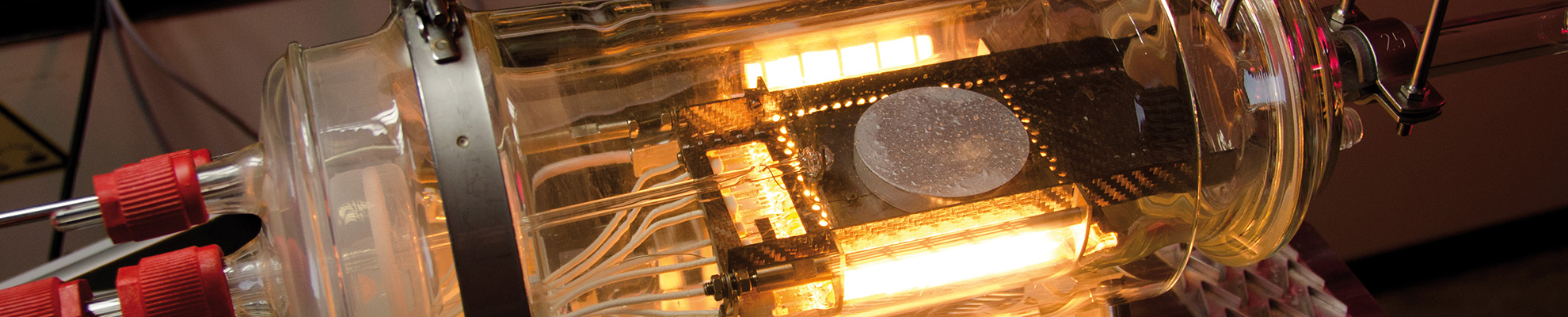



Brazing of Stainless Steel to Aluminium
for Pots and Pans Production

Oct 29
2010

1) What is the NOCOLOK® Sil Flux quantity (per cm2) required for sandwich brazing
or pressure cookers (stainless steel to aluminium)?

The recommended load for NOCOLOK® Sil Flux is approximately 15 to 25 g/m2. Brazing aluminium to stainless steel requires rapid processing, i.e. very fast heating ramp and short time at brazing temperature. Usually, this can only be accomplished with induction brazing.

Brazing of Stainless Steel to Aluminium

When brazing aluminium to stainless steel using NOCOLOK® Sil Flux, the Sil Flux first forms the filler metal from the aluminium component. The filler metal then reacts with the stainless steel to form a thin layer of FeAl3.
From a metallurgraphic point of view, there is a multi-layer system (microscopic structures). First, there is the stainless steel, then the layer of FeAl3, then the Al/Si filler metal, and finally the aluminium substrate. The FeAl3 layer is very brittle, and so it is important that this layer is kept as thin as possible. The thickness of this layer is a function of time and temperature,- consequently the need for a short brazing cycle.

2) To prepare a NOCOLOK® Sil Flux slurry or paste:
What is the exact mixing ratio (flux to solvent) required?

The mixing ratio for NOCOLOK® Sil Flux slurries or pasts depends on the application method on site. In some cases, the main focus is a specific viscosity for an automated fluxing system. In other cases, only small flux quantities are prepared for immediate consumption.
NOCOLOK® Sil Flux can be prepared with alcohol (ethanol or isopropyl alcohol) or alcohol/ water mixtures (70% alcohol content) in any ratio from 20 to 60 wt% (solids). As mentioned earlier, the actual slurry concentration will depend on the application procedure. The objective is to achieve 15 to 25 g/m2 surface area.
If the NOCOLOK® Sil Flux slurry is not completely consumed within one or two days, we recommend to use pure alcohol as carrier to avoid any chemical reaction between the solvent and the metal powder (silicon). Due to hydrolysis of the silicon powder, water should not be used to prepare NOCOLOK® Sil Flux paste. Brushing, dipping or spraying can be utilised to apply the flux. Uniformity of the applied flux coating is very important.

3) How fast after applying NOCOLOK® Sil Flux, the components should be 
processed for best results?

Before the part is heated up, the NOCOLOK® Sil Flux slurry or past coating on the component surfaces should be thoroughly dried or allowed to evaporate. If alcohol is used as a carrier, the evaporation will only take a few seconds (with 15 to 25 g/m2 flux load). NOCOLOK® Sil Flux is non hygroscopic (i.e. the flux does not attract and absorb moisture) and non-corrosive under normal conditions (i.e. there is no reaction between the flux and the metal surfaces at room temperature). If a water mixture is used as the flux carrier, the components should be dried after flux application to avoid water-based corrosion effects.

4) What is the grain/particle size distribution of the silicon metal powder
in NOCOLOK® Sil Flux?

The silicon particles in NOCOLOK® Sil Flux show a particle size distribution curve with most of the grains within a range of 10 to 45μm. The Solvay specification for NOCOLOK® Sil Flux coarse grade (which is used for brazing pots and pans) is as follows:
< 5μm: < 25%
10 to 20μm: 50%
> 35μm: < 10%

5) What are the key points regarding product fit-up for good joint formation
in NOCOLOK® Sil Flux technology?

During the brazing process it is important that the components to be joint are in intermediate contact with each other. There must be firm pressure applied on all the surfaces of the plates throughout the brazing cycle to avoid large voids and gaps. Filler metal can only fill gaps up to a certain width (i.e. approximately 0.10 to 0.15 mm).

Cladding Alloys

Sep 29
2010

Brazing sheet comprises of a core alloy clad on 1 or 2 sides with a lower melting aluminum-silicon (Al-Si) alloy. This thin layer, usually makes up 5 % to 10 % of the total thickness of the brazing sheet.

It melts and flows during the brazing process, to provide upon cooling a metallic bond between the components. It is common that the braze clad alloy are from the AA 4xxx series or more particularly AA 4343 (Al-6.8~8.2 wt.% Si).

However, if larger fillets are desirable, or if in a situation where brazing is likely to occur at lower temperatures, AA‑4045 is the preferred choice.

Manufacturing

Cross-section morphology of a double-side clad tubestock.

Aluminium brazing sheet is manufactured by roll-bonding techniques to clad a core alloy ingot on one side or both sides with a low melting AlSi alloy. As an alternative, one side can be clad with a non-braze alloy, e.g. Zn-containing alloy.

Depending on the desired final properties, the core is either homogenized or not before the cladding operation.
The whole package is subjected to preheating, hot rolling and cold rolling down to the final thickness of the respective products. Depending on the requested final properties, the material is subjected to final annealing and / or intermediate annealing operation(s).

The core provides structural integrity. It is common to use a variety of aluminium alloys, examples being AA 3xxx (AlMn), more particularly AA 3003, AA 3005, AA 3105 and modified versions of AA 3003 or AA3005 (long life alloys).

Phase diagram

Aluminum End of Al-Si Phase Diagram

The melting characteristics of the cladding alloys are governed by the Al-Si phase diagram. The eutectic composition, i.e. the amount of Si required to produce the lowest melting point is 12.6%. The melting point at this composition is 577°C. At lower Si levels the solidus or the point at which melting begins is also 577°C. However, melting occurs in a range and the temperature above which the filler is completely molten is called the liquidus. In between the solidus and liquidus, the filler is partially molten, existing both as liquid and solid. The difference between the solidus and the liquidus forms the basis for various filler metal alloys.

The table below shows the solidus and liquidus of common brazing alloys.

AlloyAA-4343AA-4045AA-4047
%Si Nominal7.510.012.0
Solidus577577577
Liquidus613591582

The higher Si alloys (e.g. AA4047) have higher fluidity and a narrower melting point range while the lower Si alloys have less fluidity with a wider, higher melting point range. Erosion of the base metal occurs when the braze alloy dissolves part of the core alloy. The extent of erosion is increased by:

  • Higher Si levels in the braze alloy
  • Longer braze cycles
  • Excessive peak brazing temperatures
  • Excessive thickness fo the braze metal layer
  • A design which allows pooling of the braze metal to occur

Zn Flux – The Alternative Flux for Corrosion Protection

Aug 27
2010

All heat exchanger manufacturers currently using zinc-coated tubes or zinc-coated brazing sheet and extrusions for corrosion protection are invited to consider NOCOLOK® Zn Flux as an alternative.

How does NOCOLOK® Zn Flux work?
The flux – a fine white powder with the chemical formula KZnF3 – is manufactured by Solvay Fluor similarly to standard NOCOLOK® Flux in a water-based batch process. Thus this material has a distinguished and uniquely homogeneous composition. Coating methods for the new product include slurry-based spraying, dipping, and painting, or electrostatic spraying for aluminium surfaces where zinc diffusion layers are required.

Zn Flux Before Brazing

Before Brazing

NOCOLOK® Zn Flux is a so-called “reactive” flux, i.e. the compound becomes active only at brazing temperature when it is in contact with aluminium. Pure KZnF3 without contact to aluminium decomposes at temperatures above 700°C. But when in contact with an aluminium substrate, this material initiates a series of reactions beginning at around 565°C. At first, a NOCOLOK®-type flux is liberated together with elemental zinc from the KZnF3 and the aluminium surface according to the following equation:

6 KZnF3 + 4 Al 3 KAlF4 + K3AlF6 + 6 Zn

The flux then dissolves the oxides present on the aluminium.

Zn Flux During Brazing

During Brazing (before filler metal melting)

Once the Al/Si eutectic melting point is reached at 577°C, the filler alloy (supplied from a clad layer by one of the base components) starts to gradually liquefy until the maximum brazing temperature is reached. During this entire period the elemental zinc, which is formed by the NOCOLOK® Zn Flux, diffuses into the surface of the base component, thus creating a zinc diffusion layer – as is also known from zinc sprayed surfaces.

The coating process for NOCOLOK® Zn Flux on aluminium components can be adjusted to provide exactly the same diffusion profiles as in zinc flame spraying. Furthermore, this material allows the modification of precise zinc levels in a much more controlled manner, because the handling of a fine powder provides increased flexibility.

Zn Flux After Brazing

After Brazing

Tests confirm the good results
Successful brazing is feasible with a NOCOLOK® Zn Flux load of just 3 – 5 g/m2 – Another step to reduce overall flux consumption – because this material provides flux and zinc at the same time. Well defined physical and chemical product properties are essential performance factors. The melting behaviour and compatibility with appropriate coating binder systems were researched by Solvay and further developed and optimised in joint projects with our customers.
Currently, the main fields of application for NOCOLOK® Zn Flux are the production of automotive condensers and next generation evaporators. The compound therefore is used together with cladded brazing sheet.

Watch the brazing process as an animated video:

Controlled Gas Plasma Depostion (CGPD)

Jul 16
2010

A new coating technology for the functionalization of semi-finished aluminium products for heat exchanger (HEX) applications has been developed by Erbslöh Aluminium GmbH with assistance from Solvay Fluor. In contrast to binder-based flux coatings, it is now possible to apply various kinds of NOCOLOK® fluxes free of any adhesives for the Controlled Atmosphere Brazing (CAB) process to aluminium surfaces, gaining economic and technological advantages. Today’s application examples include coatings on extruded condenser and evaporator tubes, and internal brazing of B-type tubes by integration in tube mills. Other applications, e.g. for selective local coatings, are conceivable.
Several aluminium substrates were coated with different NOCOLOK® fluxes/flux materials and examined in pre and post-brazed condition. As the results show, the new technology has a considerable potential in substituting or even replacing common pre-fluxing processes for CAB in HEX manufacturing.
Controlled Gas Plasma Deposition (CGPD) represents an innovative method for pre-fluxing of semi-finished products. It allows the application of pure flux by means of a plasma source with comparable adhesion properties as achieved with binder-based coatings. Due to the absence of any binder or other redundant chemicals, CGPD is not limited to any drying or hardening time, opening the way for high speed flux application. This comes hand in hand with the higher environmental friendliness of a solvent and binder-free process.

Illustration of the CGPD process

Benefits of brazed aluminium HEXs in Micro Multiport (MMP) design are:
■ Cost reduction
■ Improved performance with downsizing potential
■ Weight reduction
■ Lower refrigerant charge
■ Better corrosion performance
■ Recycling advantages
Improvements in CAB:
■ Use of pre-coated components
■ Process, quality, cost
■ Binder-free CGPD coating for easy use and high speed applications

Magnesium – Effects on Brazeability

Jul 06
2010

For added strength and machineability, certain alloys contain Mg. Most notably are the 6XXX series alloys (up to 1% Mg) that are used for fittings and machined components and the so-called long life brazing sheet alloys (up to 0.3% Mg in the core). There is a limit to the amount of Mg tolerated in NOCOLOK® Flux brazing. Up to 0.5% Mg can be tolerated in furnace brazing while around 1% Mg is tolerable for flame brazing.
When an Al alloy containing Mg is heated, the Mg diffuses to the surface and reacts with the surface oxide to form MgO and spinels of MgO:Al2O3. The diffusion is time-temperature dependent and is rapid above 425°C. These spinel oxides have reduced solubility in the molten flux. Furthermore, Mg and/or MgO can react with the flux forming compounds such as MgF2, KMgF3 and K2MgF4. All of these serve to poison the flux and significantly reduce its effectiveness.
In flame brazing, higher Mg concentrations can be tolerated since the faster heating rates do not allow the diffusing Mg enough time to appreciably decrease the beneficial effects of the flux. Flame brazing components containing > 1% Mg may be possible under some circumstances with increased flux loadings and very fast heating rates (<20 second braze cycle).
It should be noted that when one speaks of the brazing tolerance to Mg, it is the total sum of the Mg concentrations in both components:

[Mg] component 1 + [Mg] component 2 = [Mg] total

The figure below shows the effect of Mg on fillet size and geometry:

0.1% Mg

0.4% Mg

If the user is experiencing difficulties brazing and suspects elevated Mg levels as the cause, there are a couple of ways to be sure. First, check with the supplier of the alloys or perform a chemical composition analysis on the suspect alloys. This is the most certain way. Secondly, look for a golden hue on the brazed product. This is an indication that Mg alloys are being used and the color is a result of the increased oxide thickness. Furthermore, there may be a very light, almost fluffy residue on the brazed component that can literally be blown off by mouth. These visual indicators can most certainly be traced back to poor brazing results due to the presence of Mg.

Improving brazeability
There are a few ways in which the brazeability of Mg containing alloys can be improved:

  1. Increasing the flux loading. A substantial improvement is gained when increasing the flux loading up to 10 g/m2 or more in furnace brazing. In cases where there is just one component containing Mg such as in a fitting, extra flux can be brushed around the area of the joint.
  2. Increasing the heating rate. Slow heating rates allow more Mg to diffuse to the surface thereby hindering brazeability. For furnace brazing Mg containing alloys, the fastest possible heating rates achievable without sacrificing temperature uniformity will increase the tolerance to Mg.
  3. Combining increased flux loadings and faster heating rates.
  4. Maintaining proper gap tolerances and joint designs.
  5. Increasing the nitrogen flow rate to minimize furnace atmosphere contaminants that also compete to reduce brazeability.

Tip: NOCOLOK® Cs Flux

Better results are reported when using cesium containing fluxes for aluminum alloys containing Mg up to 0.6 – 0.8% Mg. Fewer leaks are observed when compared with standard flux and less porosity is noted in the joint areas. Furthermore, standard flux loads and braze cycles can be used with Cs containing fluxes.

NOCOLOK® Cs Flux is a flux of the general formula KxCsyAlFz where Cs is chemically bound. It has a melting range of 558°C – 566°C. The maximum Cs content is limited to 2% to keep the cost of the flux down. Increasing the Cs content does not increase brazeability as shown below:

Cesium reacts as a chemical buffer for Mg by forming CsMgF3 and/or Cs4Mg3F10. The flux inhibiting factors of Mg are therefore reduced.

Benefits of brazed heat exchangers –
Refrigerant charge reduction

Jun 15
2010

This increase in efficiency means the same refrigerant capacity can be produced with smaller exchange surfaces at the condenser and evaporator, with an associated reduction in piping volume, i.e. a higher heat exchange efficiency means smaller systems and lower refrigerant charge. Important given that third generation HFC refrigerant blends such as R 410 A are much more expensive than R 22 which they are now replacing.

Greater reliability, easy recycling and lower weight Aluminum alloys offer high heat conductivity but also high resistance to corrosion. Brazed heat exchangers also boast higher mechanical resistance, especially in the fin connection, so that even incorrect handling or accidental collisions cause less deterioration with time. Moreover, microchannel heat exchangers are single-alloy system components which means easy and efficient recycling. And, although aluminum brazed heat exchangers have a similar performance to all copper units of similar size, they are about three times lighter.

Yorck heat exchanger

Aluminium Core Alloys

May 21
2010

Aluminum alloys are classified according to their alloying elements. The Aluminum Association designations are listed in the table below:

Designation System for wrought aluminum alloys
Alloys series   Description or major alloying element
1xxx                  99.00% minimum Aluminum
2xxx                 Copper
3xxx                 Manganese
4xxx                 Silicon
5xxx                 Magnesium
6xxx                 Magnesium and Silicon
7xxx                 Zinc
8xxx                 Other Element
9xxx                 Unused Series

The chemical composition of each AA alloy is registered by the Aluminum Association and a few examples are listed:

Example of aluminum alloy composition limits in weight percent*

Alloy-NoSiFeCuMnMgZnCrOther eachOther total
11000.95(Si + Fe)0.05 -0.200.05–-0.10–-0.050.15
14350.150.30 -0.500.020.050.050.10–-0.030.03
30030.600.700.05 -0.201.00 -1.50–-0.10–-0.050.15
30050.600.700.301.00 -1.500.20 -0.600.250.100.050.15
60630.20 -0.600.350.100.100.45 -0.900.100.100.050.15

*Maximum, unless shown as a range

How to evaluate flux load?

Apr 22
2010

How to measure?

In the case of heat exchangers, the surface area being fluxed must first be determined. For ease of calculation, the louvers on the fin can be ignored. The radius on the fin can also be ignored.

Imagine then the fin pulled out of the heat exchanger and straightened out to form one long strip. Similarly, the surface area of the slots in the header can also be ignored.

Remember that in calculating the surface area of the heat exchanger, there are 2 sides to every tube, 2 sides to every fin and 2 sides to the headers. The total surface area is then expressed in m2: All dimensions are in meters (m) to yield a surface area in square meters.

Header


Assuming it is a cylindrical (condenser) header:

SA (m2) = (2 x 3.14 x radius of header(m)) x length of header (m) x 2 headers

Assuming it is a radiator header:

SA (m2) = length of header (m) x width of header (m) x 2 (sides/header) x 2 (headers)

Tubes

SA(m2) = width of tube(m) x length of tube (m) x 2 (sides/tube) x total number of tubes

Fins

Ignore the louvers in the fins

SA (m2) = width of fin (m) x (fin height (m) x number of fin legs/tube) x 2 ( sides/fin) x total number of fins

Total Surface area in m2 = SA headers + SA tubes + SA fins

To determine the flux loading, a degreased and thoroughly dry heat exchanger is weighed. The heat exchanger is then run through the fluxer, blow-off and dry-off section of the furnace. The heat exchanger is removed just prior to entering the brazing furnace and weighed again.

The flux coating weight is then determined using the following formula:

Weight of unit fluxed and dried (g) – weight of unit un-fluxed (g) x Surface area (m2)

To make sure that the flux loading was determined on a completely dry unit, run it through the dry-off section a second time and re-weigh.

See also: Flux loading

Benefits of brazed heat exchangers –
pressure drop reduction

Apr 06
2010

Brazing also offers the chance to change the design of heat exchangers by substituting round tubes with flat channels (microchannels) which offer improved heat transfer on both refrigerant and air sides for two reasons: better section/surface ratios, which affect the efficiency of heat exchange on the air and the refrigerant side; smaller surfaces in the air stream shadow where heat transfer is inefficient and lots of noise is generated. Brazed connections between fins and tubes are also rigid structures producing less mechanical noise in the presence of air turbulence.
More efficient heat exchange means lower air flows to exchange the desired heat, and microchannel technology already offers lower resistance to the air flow – flat is therefore better than round: reducing resistance by up to a factor of 3 under typical operating conditions (see figures below)!

Round Tubes – Air-Side Effects

Round Tubes – Air-Side Effects

Flat Tubes – Air-Side Effects

Flat Tubes – Air-Side Effects

Brazing Aluminium and Copper

Mar 19
2010

Brazing aluminium to copper is common in the refrigeration industry where copper tubes are brazed to aluminium roll-bond panels or tubes. To join aluminium and copper using brazing technology and standard NOCOLOK® Flux, flame brazing would be applicable (as well as using a low-melting flux with a low-melting filler metal). It is very similar to brazing aluminium to aluminium, but some precautions are necessary.

However, when copper is brazed to aluminium and the heating process takes too long, the copper will diffuse into the aluminium at the joints. A low melting Al-Cu alloy (Al-Cu33 eutectic temperature 548°C) is thus formatted, and this could lead to erosion by perforation.

Therefore, during the brazing process, the flame should never be directly applied to the joint, because the heat should be transferred by conduction through the parts to be brazed. As soon as the filler metal begins to melt, the flame must be quickly removed.

A second issue with brazing copper to aluminium is that the aluminium has a much lower melting point than copper (Al: app. 650°C; and Cu: above 1000°C). Therefore, the flame is usually directed on the copper. Nevertheless, once the heat transferred from the copper to the aluminium reaches the melting range of aluminium, it will start to burn down very fast, while the copper is still taking the heat. The formation of the above mentioned low melting Al-Cu alloy accelerates the destruction of the aluminium components.

Consequently, flame Brazing of aluminium to copper is a delicate process and requires some experience. But it is used by many companies for large scale production. But it is next to impossible in furnace brazing. There are no conventional furnace designs which will cool quickly enough to halt the continual formation of the aluminium-copper eutectic. For this reason, brazing copper to aluminium in a furnace is not practiced.

There are three different ways to provide (or generate) filler metal in flame brazing of aluminium to copper.

  • Use of Al-Si filler alloy (Al-Si 12 – AA4047). Standard procedure like in flame brazing of aluminium to aluminium – just a little bit faster to avoid burn-through.
  • Rely on the formation of Al-Cu alloy during the brazing cycle. If this method is used, a support provided by a thin Stainless Steel tube along the interior joint area can provide additional structural integrity.
  • A pre-heated copper tube is inserted very fast into an aluminium tube. The mechanical energy released will generate additional heat. Abrasion of surface oxide by the inserted tube promotes the formation of Al-Cu filler alloy. This process works with and without flux (however, results are better with flux).